Atoms are tiny… like seriously tiny. You can’t see them, not even with a regular microscope. But these invisible specks hold the secrets to some of the most powerful forces in our universe. From glowing light bulbs to gigantic nuclear power plants — atoms are behind it all.
So what is it about atoms that makes them so… powerful?
Let’s start at the very beginning.
Everything Around You Is Made of Atoms
Look around — your notebook, your pencil, the air, your hands, even your thoughts. Everything is made of atoms. These are the basic building blocks of all matter. If you were to cut something smaller and smaller and keep going… at some point, you’d reach atoms.
An atom is about one ten-millionth the size of a human hair. That’s so small you could fit millions of them inside a single grain of sand.
But size isn’t everything.
Inside each atom is a tiny universe of particles buzzing around — and that’s where the real magic happens.
The Tiny Team Inside Every Atom
Each atom is made up of three main parts:
- Protons (they carry a positive charge)
- Neutrons (they have no charge)
- Electrons (they’re negatively charged)
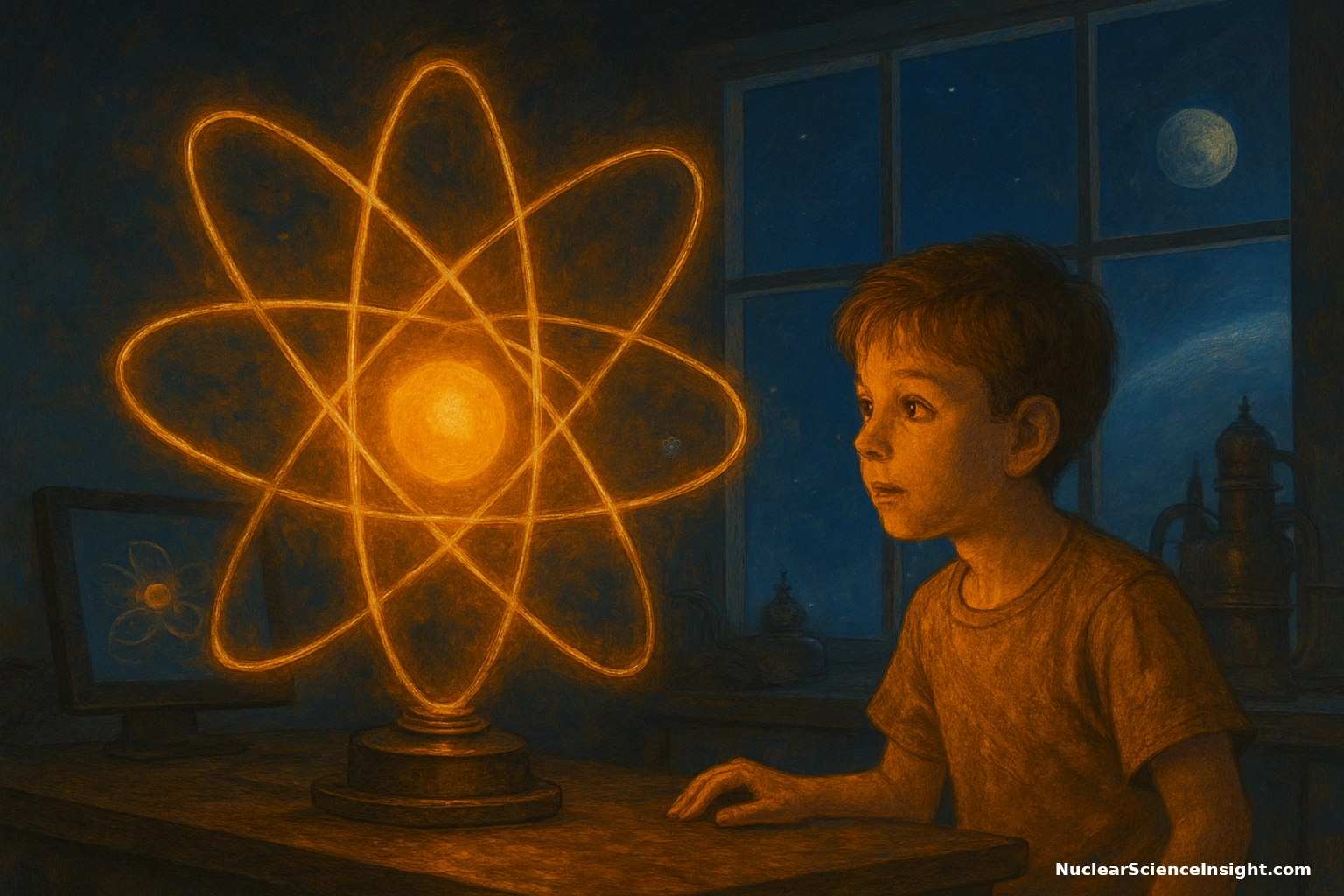
The protons and neutrons huddle together in the center of the atom — this is called the nucleus. It’s like the brain or heart of the atom. The electrons spin around the nucleus really fast, kind of like how planets orbit the sun… except way faster.
Here’s a fun fact — if the atom were the size of a football stadium, the nucleus would be like a tiny marble sitting at the center. That’s how much empty space atoms actually have.
So Where Does the Power Come From?
Now this is where things get interesting.
The power of the atom comes from the nucleus — that tiny central core holding the protons and neutrons together. Even though it’s super small, it’s packed with energy. And if we find a way to split it or join it… boom… energy gets released.
There are two ways atoms can release energy:
- Fission – when you split a big atom into smaller ones (used in nuclear power plants)
- Fusion – when you combine small atoms into bigger ones (what powers the Sun)
Both of these processes unlock huge amounts of energy from just a small bit of matter. That’s why people call atomic energy powerful. It’s not about size… it’s about what’s inside.
One Tiny Piece = Massive Energy
Let’s say you take one gram of uranium — about the size of a small paperclip. If you could split all its atoms, it would release as much energy as burning several tons of coal. That’s insane, right?
That’s exactly what nuclear power plants do. They take special atoms (like uranium-235), split them in a controlled way using fission, and use that heat to make steam. The steam turns turbines… turbines generate electricity. That electricity lights up cities.
So yes… your ceiling fan or fridge could be powered by an atom split thousands of kilometers away.
But Wait — Who Discovered All This?
Let’s jump into a bit of history…
- John Dalton (early 1800s) said matter is made of tiny particles called atoms.
- J.J. Thomson discovered electrons.
- Ernest Rutherford cracked open the idea of the nucleus.
- Niels Bohr explained how electrons orbit in shells.
- Albert Einstein (yep, that guy) showed how mass can turn into energy:
E = mc²… and that’s the secret formula behind atomic energy.
Later, scientists in the 1930s and 40s figured out how to actually split the atom. This discovery changed the world — both in good ways (energy, medicine, space) and bad ways (atomic bombs). It’s a power we must use wisely.
How Atoms Changed Our World
Atomic energy isn’t just about big machines or scary stories. It’s helped humanity in many ways.
- Clean Electricity: Nuclear power plants generate lots of energy without air pollution.
- Medical Tools: Radiation from atoms is used to treat cancer.
- Space Travel: Nuclear systems help power spacecraft that travel far beyond Earth.
- Food Safety: Atoms are used to kill germs in food without cooking it.
In places like France, Japan, Russia, the USA, and India — nuclear energy is a key part of how people get electricity every day.
But Is It Safe?
This is a good question… and it’s one that scientists ask too.
The truth is, nuclear energy is very powerful, so it must be handled with care. Accidents like Chernobyl or Fukushima remind us what happens when safety systems fail.
But here’s the thing: modern reactors are way safer, with more backups, better designs, and trained teams who know what they’re doing. In fact, nuclear energy is statistically safer than coal or oil when you count health effects and pollution.
And now, researchers are working hard on fusion energy — a clean, safe way of copying what the Sun does… but on Earth. If they succeed, we could power the whole world with no pollution and no waste.
India’s Atomic Journey
Let’s not forget — India has been a pioneer in peaceful nuclear development. From setting up the Bhabha Atomic Research Centre (BARC) to building indigenous nuclear reactors and contributing to global fusion projects, the journey has been inspiring.
India is also part of ITER, the world’s biggest fusion experiment in France. That means young scientists from Bharat could be the ones who help unlock clean fusion energy for the whole planet.
Why Kids Should Learn About Atoms
Here’s something not many people say — atomic science isn’t just for grown-ups.
It’s fascinating… it connects to everything from physics and chemistry to space and energy… and it gives you a way to understand the world better. You don’t need to be a genius. You just need to be curious.
And honestly? The next generation of fusion engineers, reactor designers, or clean-energy leaders could be kids reading this right now…
Want to Explore Atoms Even More?
If you’re curious about this invisible world of energy, atoms, and science — we’ve got just the thing.
📘 Check out our book:
Nuclear Science for Young Minds
https://a.co/d/8RpUaF1
It’s packed with fun facts, stories, pictures, and easy explanations to help kids and beginners understand nuclear science — the friendly way.
Whether you’re 10 or 100… it’s never too early (or too late) to explore the science of the atom.